By Chicago Times Magazine –
May 2, 2026
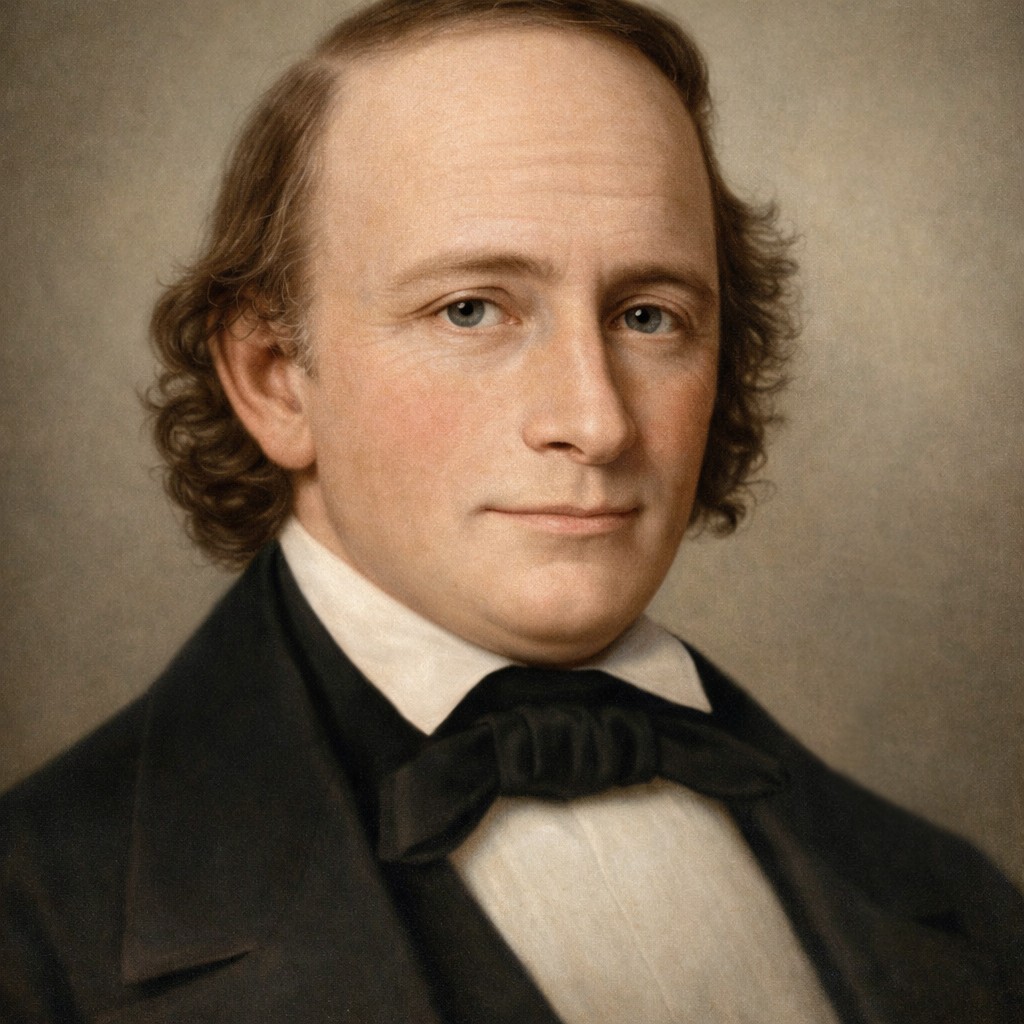
Augustus Garrett’s life reads like an early Chicago fable—ambitious, uneven, marked by reinvention, and inseparable from the city’s own turbulent rise. Born in 1801 in New York, Garrett spent his early adulthood moving through the commercial circuits of Cincinnati and New Orleans, chasing opportunity with the restless energy that would later define his political career. His time in New Orleans was marred by financial collapse and personal tragedy, including the death of his young daughter during a cholera outbreak in 1833. Yet Garrett and his wife, Eliza Clark, refused to be undone. They regrouped, relocated, and in 1835 arrived in Chicago, a frontier settlement on the cusp of explosive growth. The city was muddy, chaotic, and full of promise—exactly the kind of place where a man like Garrett could start over.
Chicago proved to be fertile ground. Garrett opened an auction house near the river, partnering with the Brown Brothers, and quickly became one of the city’s most successful businessmen. In 1836 alone, his auction sales reportedly exceeded $1.8 million, a staggering figure for a settlement that had incorporated as a city only three years earlier. Land speculation was rampant, fortunes were made and lost overnight, and Garrett’s sharp instincts allowed him to ride the wave with remarkable success. His business prominence naturally drew him into civic life, and by 1840 he was serving as alderman of the 2nd Ward, where he developed a reputation as a shrewd operator who understood both the city’s needs and its political undercurrents.
Garrett first ran for mayor in 1842 and lost, but he returned the following year and won, becoming Chicago’s seventh mayor. His first term, from 1843 to 1844, unfolded during a period of rapid population growth and infrastructural strain. Chicago was transforming from a rough settlement into a bustling commercial hub, and Garrett approached the mayoralty with a businessman’s eye for efficiency and order. Yet his political fortunes took a dramatic turn in 1844. Although he initially won re-election, the results were invalidated after allegations of “illegal proceedings and fraud.” A second election was held, and Garrett lost to Alson Sherman. The episode remains one of the earliest examples of the contentious, often bruising political culture that would become a Chicago hallmark.
Undeterred, Garrett ran again in 1845 and reclaimed the mayor’s office. His second term was more assertive, shaped by his belief in strong civic management and practical resource allocation. One of his most controversial positions involved the Dearborn School, Chicago’s first brick schoolhouse. Garrett argued that the building was too large for educational use and advocated converting it into either a warehouse or an insane asylum. His stance reflected a broader tension in early Chicago: the struggle to balance public investment with the immediate, pragmatic needs of a rapidly expanding city. To Garrett, every structure and every dollar had to serve the city’s growth, even if that meant challenging emerging civic ideals about education and public welfare.
Garrett’s personal life was as complex as his political one. He and Eliza had endured financial ruin, the death of a child, and multiple relocations before finding stability in Chicago. Their resilience mirrored the city’s own ability to rebound from adversity. Although some early records suggest the couple had children, later accounts emphasize that they ultimately left no surviving heirs. Their estate funded the Garrett Biblical Institute, which later became part of the Garrett-Evangelical Theological Seminary at Northwestern University. This institution remains one of the most enduring legacies attached to Garrett’s name, a testament to the couple’s commitment to education and religious scholarship despite Garrett’s earlier skepticism about certain public institutions.
Garrett died on November 30, 1848, at the Sherman House Hotel, one of Chicago’s early landmarks. He was buried at Rosehill Cemetery, joining the ranks of many early civic leaders whose names now populate the city’s historical landscape. His death marked the end of a career that had helped shape Chicago during its formative years, but his influence lingered in the city’s political culture, commercial development, and institutional foundations.
Assessing Garrett’s legacy requires acknowledging its contradictions. He was a businessman who thrived in the speculative frenzy of early Chicago, yet he also understood the need for civic structure. He was a politician who experienced both victory and scandal, reflecting the volatility of a city still defining its political identity. He was a civic figure whose decisions sometimes clashed with emerging public values, yet he contributed to institutions that would outlast him by generations. Garrett embodied the restless, opportunistic spirit of early Chicago—a city where ambition could propel a person to great heights, and where reinvention was not just possible but expected.
Today, Garrett’s story offers a window into the origins of Chicago’s political and civic character. His career underscores the volatility of early elections, the entrepreneurial drive that shaped the city’s leadership, and the ongoing tension between public good and private interest. While he may not be the most famous of Chicago’s mayors, his life captures the essence of a city in transition: ambitious, resilient, and perpetually in motion. In many ways, Garrett’s Chicago was a place still discovering what it wanted to become, and his own journey—marked by reinvention, controversy, and determination—mirrored that search for identity.