By Chicago Times Magazine –
January 31, 2026
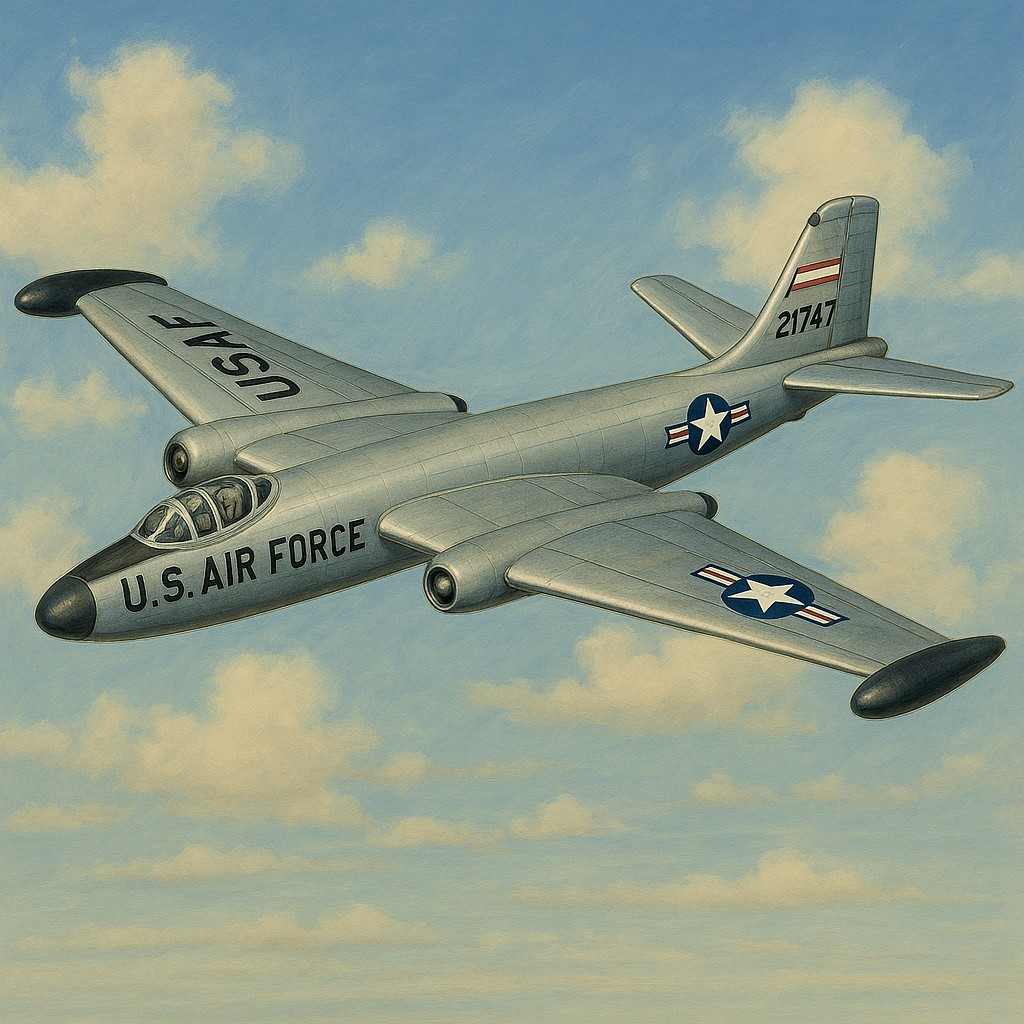
The Martin B-57 Canberra stands as a remarkable testament to the longevity of mid-century aerospace engineering, a twin-engine jet that has defied the typical lifecycle of military hardware to remain a vital asset in the twenty-first century. Originally conceived as a tactical bomber to replace the aging piston-driven Douglas B-26 Invader during the early years of the Cold War, the B-57 was born from a rare moment of transatlantic cooperation. In the early 1950s, the United States Air Force found itself in urgent need of an all-weather interdictor capable of operating in the demanding environment of the Korean Peninsula. When domestic designs failed to meet the rigorous specifications for speed, altitude, and range, the Pentagon looked toward Great Britain and the English Electric Canberra. This decision marked the first time since World War I that the United States would manufacture a foreign-designed aircraft under license, a task entrusted to the Glenn L. Martin Company of Baltimore.
The transition from British blueprints to American production was not merely a matter of translation; it required a significant overhaul of the aircraft’s internals to accommodate American engines, avionics, and manufacturing standards. The original Rolls-Royce Avon engines were replaced with the Wright J65 turbojet, a licensed version of the Armstrong Siddeley Sapphire, providing the thrust necessary for the heavy-lift requirements of the Air Force. The Martin engineers also introduced a revolutionary rotary bomb bay, which allowed for high-speed ordnance delivery with minimal aerodynamic disruption. While the early B-57A models remained close to the original British design, the definitive B-57B variant introduced a tandem cockpit with a fighter-style canopy, a significant departure from the side-by-side seating of its predecessor, which greatly improved visibility for the crew during low-level strike missions.
Throughout the 1960s, the B-57 earned its reputation as a rugged and versatile platform, particularly during the Vietnam War. Flying night interdiction missions over the Ho Chi Minh Trail, the aircraft, often painted in a distinctive gloss black, became a ghost in the darkness, utilizing early versions of forward-looking infrared and laser-guidance systems. It was during this conflict that the Canberra achieved the distinction of being the first American jet bomber to drop bombs in combat. Despite its success as a “Night Intruder,” the rapid advancement of surface-to-air missile technology and supersonic interceptors eventually pushed the Canberra out of its primary combat role. The Air Force began retiring its fleet in the 1970s, with the final operational units being phased out by 1983. Yet, as the military turned its back on the aging airframe, a new chapter was beginning in the world of high-altitude research.
While the standard bomber variants were being sent to the “boneyard” in Arizona, a specialized evolution of the aircraft was taking flight. The WB-57F, or the “Long Wing” Canberra, was a radical modification designed for extreme altitude weather reconnaissance and atmospheric sampling. These aircraft featured massive wingspans of 122 feet—nearly double that of the original bomber—allowing them to soar to altitudes exceeding 60,000 feet. NASA recognized the unique potential of these planes, acquiring a small fleet to serve as high-altitude laboratories. Operating out of Ellington Field near the Johnson Space Center in Houston, these “flying science benches” became indispensable for calibrating satellite sensors, sampling cosmic dust, and providing high-definition imagery of rocket launches and astronomical events. For decades, the three remaining NASA WB-57s have occupied a niche that no modern drone or satellite can fully replicate, offering a combination of heavy payload capacity, human-in-the-loop flexibility, and extreme endurance.
The inherent risks of operating vintage aircraft at the edge of space were brought into sharp focus on January 27, 2026, when one of NASA’s three WB-57s, tail number N927NA, was involved in a dramatic emergency at Ellington Airport. The aircraft, which had been famously resurrected from the Davis-Monthan boneyard in 2013 after 41 years in storage, encountered a critical mechanical failure during its approach. As the crew prepared for landing around 11:30 a.m., it became clear that the landing gear would not deploy. With limited options and fuel dwindling, the pilot was forced to execute a gear-up belly landing on Runway 17R-35L.
Witnesses and local news crews captured the heart-stopping moment the rare jet touched down. Moving at well over 100 miles per hour, the aircraft’s fuselage made direct contact with the concrete, sending a spectacular shower of sparks and bright yellow flames trailing behind as it skidded down the centerline. Despite the violent friction and the visible smoke billowing from the underside, the pilot maintained incredible directional control, keeping the massive 122-foot wings level and preventing the aircraft from veering off the runway. The jet eventually came to a smooth, if noisy, halt, resting squarely on its belly. Emergency crews, including specialized fire teams, were on the scene within seconds, dousing the airframe with foam as the two crew members—a pilot and a sensor equipment operator—were safely extracted.
The successful recovery of the crew without injury was hailed as a masterclass in emergency piloting, but the incident left the future of N927NA in question. As one of only three such aircraft in existence, every airframe is a priceless asset to the scientific community. The belly of the aircraft, which houses complex sensor bays and structural supports, sustained significant abrasions and heat damage from the friction of the slide. NASA officials immediately grounded the remaining fleet to conduct a thorough investigation into the landing gear’s mechanical failure, seeking to determine if the issue was a result of component fatigue in the aging system or a more systemic maintenance concern. The loss of even one aircraft, even temporarily, creates a significant bottleneck for the Airborne Science Program, particularly with upcoming missions scheduled to track high-profile satellite launches and conduct atmospheric studies over the Pacific.
The resilience of the Martin B-57 Canberra is a paradox of modern aviation. It is a plane that should, by all accounts, be a museum piece, yet it remains on the front lines of human knowledge. Its heavy-duty construction, designed to withstand the stresses of low-level bombing runs in the 1950s, has proven to be the very thing that allows it to survive the unforgiving environment of the upper atmosphere—and, as seen in Houston, a high-speed slide across a concrete runway. The “Long Wing” Canberra represents a bridge between the era of slide rules and the era of quantum sensors. While the 2026 belly landing was a reminder of the fragility of mechanical systems, it also highlighted the durability of a design that refused to stay retired.
As NASA engineers work to assess the structural integrity of the damaged aircraft, the story of the B-57 continues to evolve. There is no modern successor waiting in the wings that offers the same “dirty” capability—the ability to fly a human being and several tons of sensitive instruments into the stratosphere with a reliable, twin-engine safety margin. Whether N927NA returns to the skies or becomes a source of spare parts to keep its two siblings flying, the legacy of the Canberra is secure. It remains an icon of adaptability, proving that with enough care and engineering ingenuity, a Cold War warrior can find a permanent home among the stars. The sparks on the Ellington runway were not a funeral pyre, but a dramatic footnote in the ongoing saga of an aircraft that simply refuses to stop flying.
Feature image: B-57 – Chicago Times Magazine Artist