By Chicago Times Magazine
January 23, 2026
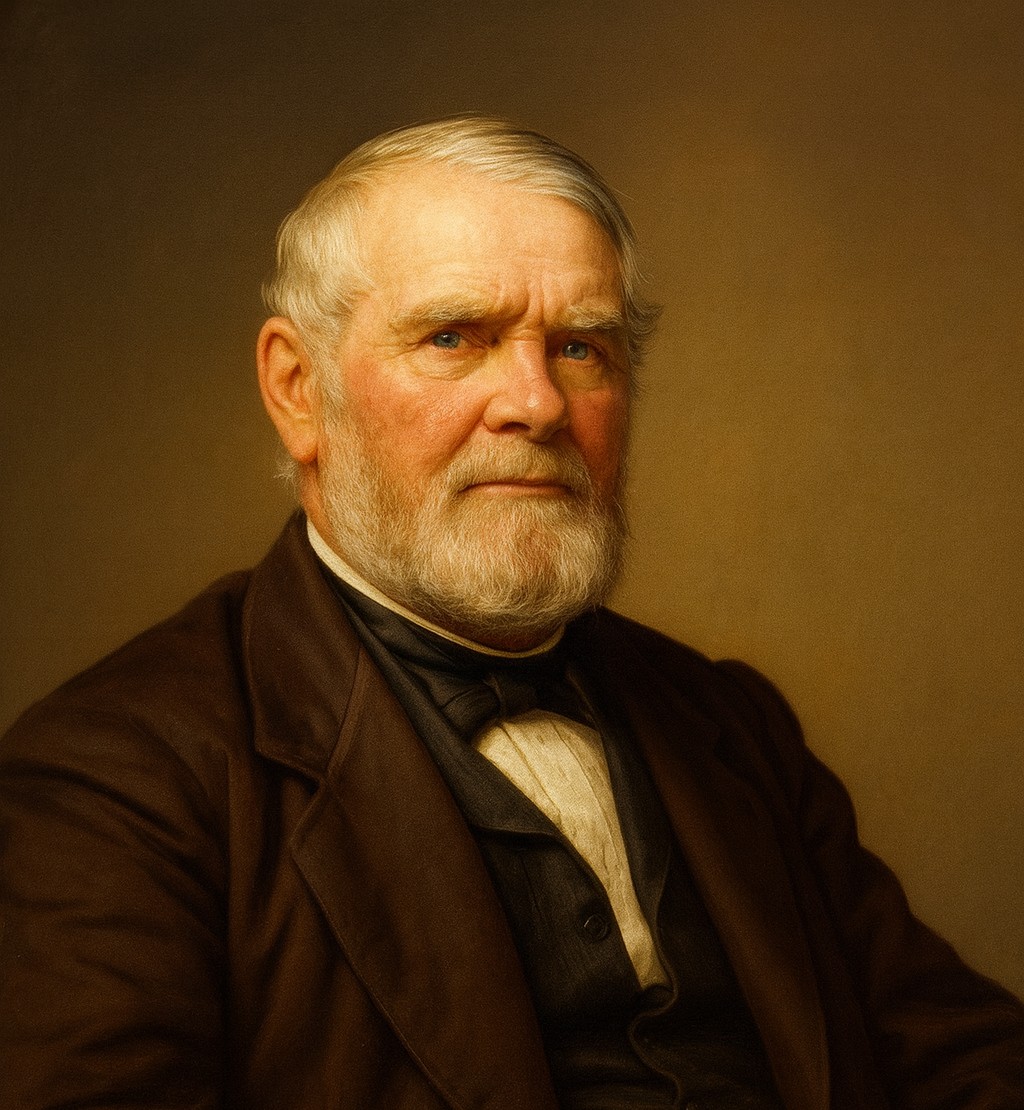
William Butler Ogden was not merely Chicago’s first mayor; he was the primary architect of its transition from a swampy frontier outpost to a global metropolis. His life followed the classic arc of the 19th-century American “Empire Builder,” characterized by relentless optimism, speculative grit, and a profound belief in the power of infrastructure. Born on June 15, 1805, in Walton, New York, Ogden grew up in a family of means, but his ambitions soon outgrew the Catskills. He initially entered politics in New York, serving in the state legislature, where he became a staunch advocate for the Erie Railroad. This early exposure to the transformative power of rail would define his later career and his vision for the American West.
Ogden arrived in Chicago in 1835 to manage real estate investments for his brother-in-law, Charles Butler. Legend has it that upon seeing the muddy, desolate flatlands of the Chicago River, Ogden was initially dismayed, believing the land was worth far less than the money invested. However, he quickly pivoted. Recognizing the geographical potential of the site—situated at the crux of the Great Lakes and the Mississippi River watershed—he began draining land, laying out streets, and selling lots with a vigor that earned him the moniker “the Astor of Chicago.” He was a man who saw a city where others only saw a swamp.
When Chicago officially incorporated as a city in 1837, the population hovered around 4,000. Ogden, running as a Democrat, won the inaugural mayoral election by a landslide. His tenure was defined by the Panic of 1837, a severe financial depression that threatened to bankrupt the fledgling city before it could even begin. As mayor, Ogden’s greatest contribution was his refusal to let the city succumb to the economic gloom. He famously advocated for the “honorable fulfillment” of debts rather than repudiation, which helped maintain Chicago’s credit rating in eastern markets. His administration focused on the most basic, yet vital, urban necessities, including the construction of the first swing bridge over the Chicago River at Clark Street and early drainage projects to combat the city’s notorious mud and the resulting outbreaks of cholera. He also established the city’s first formal fire department and police force, setting the precedent for the “Chicago Spirit”—a blend of private enterprise and public development.
After his term ended, Ogden remained the city’s most influential citizen. He realized that for Chicago to dominate the West, it could not rely solely on the Illinois and Michigan Canal; it needed rails. In 1848, Ogden founded the Galena and Chicago Union Railroad. When eastern investors refused to back the project, Ogden personally rode across the prairies of Northern Illinois, selling shares to farmers and small-town merchants from the back of a buggy. It became the first railroad to run out of Chicago, eventually evolving into the Chicago and North Western Railway. Ogden’s fingerprints were on nearly every major development in the city during this era. He provided the land and capital that allowed Cyrus McCormick to build his reaper factory in Chicago, effectively making the city the center of the agricultural world. Furthermore, he was a founder of the Chicago Historical Society and a primary benefactor of the University of Chicago and Rush Medical College.
In his later years, Ogden moved to a sprawling estate called “Boscobel” in New York, but his heart and business interests remained tethered to the West. He served as the first president of the Union Pacific Railroad, helping to oversee the completion of the Transcontinental Railroad. When the Great Chicago Fire of 1871 decimated the city, Ogden returned to help lead the relief effort, despite losing his own massive Chicago mansion and much of his fortune in the blaze. His resilience in the face of the fire mirrored his response to the Panic of 1837, proving that his commitment to the city was not merely financial, but foundational.
William B. Ogden died in 1877, leaving behind a city that had grown from a few huts to a population of nearly half a million during his lifetime. He was the quintessential urban visionary who understood that a city is not just a collection of buildings, but a network of connections. By linking Chicago to the East via rail and the West via commerce, he ensured that the “City in a Garden” would become the undisputed hub of the American continent. His legacy persists in the very grid of the city and the rail lines that continue to pulse through its heart.