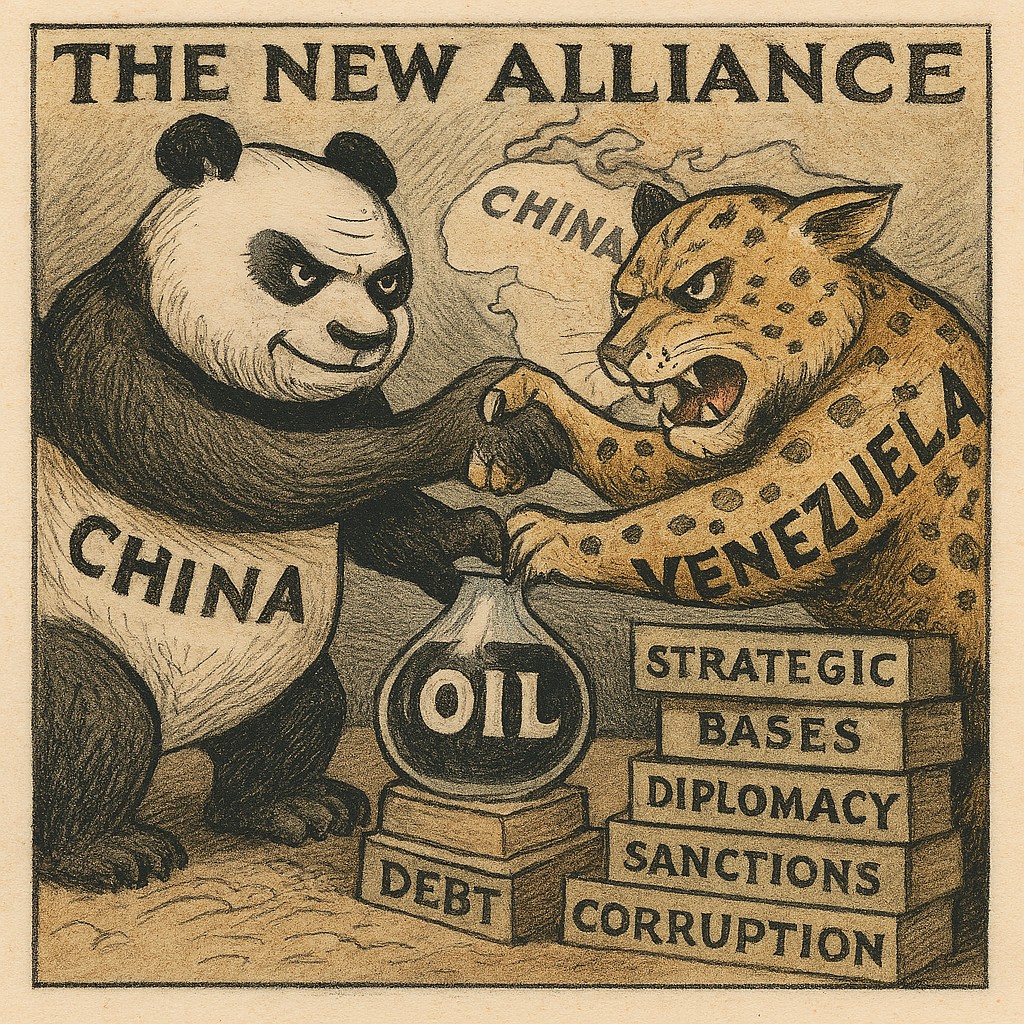
By E.W. Colby, Chicago Times Magazine –
November 12, 2025
In the calm moments between crises, the business of statecraft is best understood as the steady cataloguing of capability and intent. Today those pages are filled with a partnership that, if left unaddressed, could quietly alter the strategic map of the Western Hemisphere: an expanding slate of economic, political, and security ties between Communist China and Venezuela. What appears at first glance as credit lines and trade pacts carries with it the potential to translate influence into operational reach — a matter that merits sober assessment rather than hyperbole.
Communist China’s commitments in Venezuela are not new; they are the continuation of an investment strategy begun decades ago. What is new is the tempo and breadth of recent moves: preferential trade agreements, expanded lines of credit, and a diplomatic embrace timed against increased United States pressure in the region. For Venezuela, these ties are lifelines that buy breathing room; for Communist China, they are strategic leverage — not merely commercial, but geopolitical. The shape of this leverage matters: when a major power backs a faltering regime with finance, logistics, and political protection, it does more than support an ally. It creates a zone where its preferences, procedures, and hardware become the default choices of state institutions.
Economics underwrites geopolitics. Communist China’s lending to Venezuela over the last quarter-century has reached the scale of tens of billions of dollars, much of it repaid or secured through oil concessions and preferential purchase agreements. Those financial arrangements have given Communist Chinese firms preferential access to energy infrastructure, mining projects, and state procurement. The implications are twofold. First, long-term economic dependence opens avenues for Communist China to shape Venezuela’s external alignment and internal choices. Second, the presence of Communist Chinese investment in critical infrastructure — ports, refineries, telecommunications — raises questions about the ability of a distant power to project influence in peacetime and advantage in crisis.
A second vector of concern is politico-military cooperation. Venezuela’ persistent overtures for defensive equipment, radar upgrades, and advisory exchanges underline a desire to modernize capabilities and reduce strategic vulnerability. International suppliers who see commercial opportunities are not indifferent to the political consequences of their sales. Whether through direct hardware transfers, training programs, or permissive access arrangements, the introduction of external military technology into Venezuelan forces has bearings on regional stability and crisis escalation ladders.
The United States faces a familiar strategic dilemma: how to deter the conversion of influence into operational advantage without producing the very crisis that could justify deeper foreign entrenchment. Heavy-handed measures risk driving Venezuela and Communist China closer together; inaction risks seeing an adversary secure a durable foothold just beyond U.S. perimeters. Historically, the most effective responses blend clarity of purpose with layered, calibrated tools — diplomatic engagement to undercut zero-sum narratives, economic alternatives to blunt dependency, and discreet signaling to raise costs for military entrenchment.
One practical axis of policy is regional resilience. Latin American states themselves are the first line of defense against external domination. Efforts that reinforce market access, investment diversification, and transparent governance reduce the appeal of transactional, extractive partners. Strengthening multilateral fora, expanding infrastructure financing alternatives, and supporting civil-society mechanisms that demand accountability from their leaders undercut the conditions that allow a single external patron to dominate policy choices.
Intelligence and anticipatory analysis also matter. The subtlety of modern influence operations is often their strength: commercial agreements that carry implicit strings, infrastructure projects that include clauses favoring foreign personnel or technologies, or barter arrangements that sidestep normal oversight. Systematic, interagency tracking of such patterns — and the willingness to act when thresholds of strategic risk are crossed — should be standard practice. The private sector is a partner in this enterprise; banks, contractors, and insurers can be dissuaded from participating in ventures that institutionalize dependency or sidestep legal norms.
Military signaling must be precise, not theatrical. The objective is deterrence, not entrapment. Demonstrations of presence and readiness, coordinated with regional partners, can complicate plans to establish military basing or secure exclusive access to facilities. At the same time, unnecessary escalation serves the narrative of outside threat that binds Venezuela and Communist China more tightly. Successful deterrence in this context is measured in prevention and persistence, not dramatic blows.
A final layer is the contest of narratives. Communist China presents its outreach as benign cooperation among sovereign states; Venezuela frames external criticism as imperial overreach. Those narratives are persuasive when alternatives are absent. The counter-narrative is straightforward: sovereignty is meaningful only when paired with accountability and the capacity to meet citizens’ needs. Policies that highlight corruption, mismanagement, and the human costs of closed bargains deprive predatory partnerships of their moral cover.
Risk management in foreign policy is an exercise in probabilities and timelines. The probability that China will seek to translate commercial ties into operational advantage in Venezuela is real; the timeline for any consequential shift depends on a mix of economic need in Venezuela, geostrategic calculation in Communist China, and the policy responses of regional and global actors. Absent careful, coordinated action, the result could be a fait accompli: a foreign power with bespoke access to energy supplies, critical infrastructure, and political influence in America’s neighborhood.
History offers the caution that the balance of influence rarely changes overnight; it changes by accretion. The prudent course, therefore, is to act early, with instruments that preserve options and build resilience among partners. The aim should be to render coercive leverage ineffective — not by force alone, but by denying it the fertile ground of dependency. In that quiet, methodical way, a free and secure order is best defended.
Feature image: Panda and the Jaguar – Chicago Times Magazine Artist