By Chicago Times Magazine
January 7, 2026
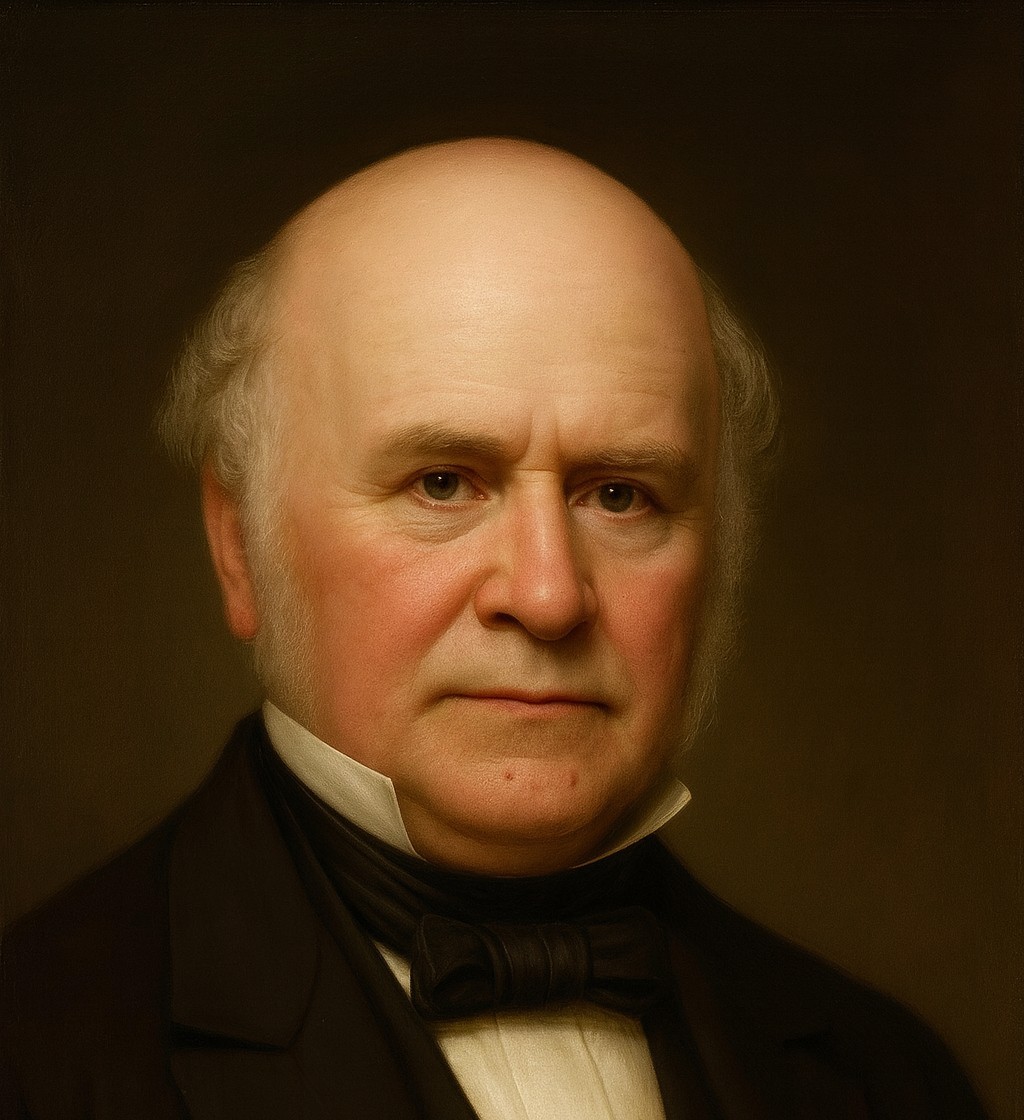
The year was 1836 when a young merchant from Rome, New York, stepped onto the muddy, marshy shores of a fledgling settlement known as Chicago. Benjamin Wright Raymond did not arrive with the swagger of a conqueror, but with the quiet determination of a man who saw potential where others saw only a swamp. He was thirty-five years old, seasoned by years of mercantile work in East Bloomfield and Montreal, and backed by the financial confidence of his friend Simon Newton Dexter. Chicago was not yet a city—it was a promise, a collection of wooden shanties and ambitious dreams huddled near the mouth of the Chicago River. Within three years of his arrival, Raymond would be elected the third mayor of this rising metropolis, steering it through one of the most perilous financial storms in American history. His story is not merely one of political office, but of a civic architect who laid the physical and economic foundations of the Midwest.
Raymond’s early life was defined by the rigorous education and disciplined work ethic common to the post-Revolutionary generation. Born in 1801, he attended St. Lawrence Academy in Potsdam, New York, and spent time in Canada, honing a sense of pragmatism that would later define his governance. When he arrived in Chicago, the town was gripped by the speculative frenzy of the mid-1830s. Land values were skyrocketing, and the air was thick with the scent of easy money. However, Raymond was a Whig by conviction, a party that favored stability, infrastructure, and a cautious approach to credit. This philosophical grounding became his greatest asset when the Panic of 1837 struck, collapsing banks and sending the young city’s economy into a tailspin. While many of his contemporaries were ruined by debt, Raymond maintained a reputation for sobriety and integrity, leading to his election as mayor in 1839.
His first term as mayor was characterized by an almost monastic devotion to the public good. The city was broke, its currency was largely worthless “shinplasters,” and its residents were struggling to pay for basic services. His primary focus was the preservation of Chicago’s credit. By practicing “rigid economy,” as he later described it in his 1842 inaugural address, he ensured that the city remained solvent when other Western outposts were declaring bankruptcy. This fiscal conservatism wasn’t born of greed, but of a desire to build a city that could withstand the centuries.
One of Raymond’s most enduring contributions to the physical layout of Chicago occurred during this first term. When the federal government decided to sell the land occupied by Fort Dearborn, there was a risk that the historic site would be carved up into small, disorganized lots for quick profit. Raymond successfully lobbied and secured a significant portion of this land for the city, ensuring that the lakefront and the strategic heart of the settlement remained under public control. He was also instrumental in the widening of State Street. At a time when streets were often little more than narrow, sewage-clogged alleys, Raymond envisioned a grand, wide thoroughfare that could handle the commerce of a major city. His insistence on a broad right-of-way for State Street fixed the spine of Chicago’s future downtown long before the first skyscrapers were ever imagined.
Political life in the 1840s was volatile, and Raymond’s first stint in office lasted only a year. He lost his reelection bid in 1840 to Alexander Loyd, a Democrat, as the national political winds shifted. Yet, the people of Chicago knew a steady hand when they saw one. In 1842, after a period of further economic instability under his successors, Raymond was called back to the mayoralty as the city’s sixth mayor. His second term focused on internal improvements and the professionalization of city services. He addressed the “peculiar nature” of Chicago’s soil—a polite way of describing the mud that frequently swallowed wagons whole—by initiating better grading and drainage projects. He also championed the development of the city’s first organized fire defenses, recognizing that a city built of wood and ambition was always one spark away from oblivion.
Despite his political successes, Benjamin Wright Raymond was perhaps even more significant as a venture capitalist and industrialist. He was a man who believed that the prosperity of Chicago was inextricably linked to the prosperity of the surrounding region. In 1843, after leaving the mayor’s office for the second time, he looked westward to the Fox River Valley. There, in the town of Elgin, he and Simon Newton Dexter established the first woolen factory in the state of Illinois. This was a radical move; the Midwest was still largely seen as a source of raw materials, not a center for manufacturing. By bringing industry to the prairie, Raymond helped diversify the regional economy, proving that Illinois could produce finished goods as well as grain and timber.
Raymond’s influence on Elgin would eventually eclipse even his political legacy in Chicago. In 1864, he was approached by J.C. Adams, who represented the interests of the Waltham Watch Company. Adams wanted to start a watch factory in the West, and Raymond saw the potential immediately. He put up the necessary capital and persuaded the citizens of Elgin to donate land for the factory. This was the birth of the Elgin National Watch Company, which would go on to become one of the largest and most famous watch manufacturers in the world. The company’s very first model was named the “B.W. Raymond” in his honor, a precision timepiece that became the standard for railroad workers across the continent. For Raymond, the watch company was more than a business; it was a symbol of the precision and reliability he believed were the hallmarks of a civilized society.
His vision extended to the intellectual and spiritual life of the state as well. In the 1850s, Raymond became one of the primary drivers behind the creation of Lake Forest, Illinois. He didn’t just want to build a residential suburb; he wanted to create a center of higher learning. He was instrumental in securing the charter for Lake Forest University (now Lake Forest College), believing that the rugged commerce of Chicago needed to be balanced by the refining influence of education and the arts. He helped plan the layout of the town, ensuring it had the same spacious, organized feel he had once advocated for on State Street. Whether he was building a railroad—serving as president of the Fox River Railroad—or founding a university, Raymond was always looking at the “big picture” of how a civilization is constructed.
As a Whig, Raymond belonged to a party that eventually fractured over the issue of slavery, giving way to the rise of the Republican Party. Raymond transitioned into this new political landscape with his principles intact. He was a man of the “old school,” a civic-minded titan who viewed wealth as a tool for community advancement rather than personal hoarding. His later years were spent in Chicago, where he remained a respected elder statesman. He watched as the town he had helped incorporate grew into a massive industrial hub, survive the Great Fire of 1871, and rebuild with a ferocity that echoed his own early struggles against the swamp.
When Benjamin Wright Raymond died in April 1883 at the age of eighty-one, the Chicago Tribune noted his passing with a solemnity reserved for the city’s true founding fathers. He was buried in Graceland Cemetery, resting among the other giants of Chicago history—men like William B. Ogden and Marshall Field. Yet, Raymond’s legacy is perhaps more quietly woven into the fabric of the region than some of his more boisterous peers. It is found in the wide stretch of State Street, the enduring reputation of Lake Forest College, and the historical archives of the Elgin Watch Company.
Raymond represented a specific type of American leadership: the merchant-statesman. He understood that a city is not just a collection of buildings, but a series of systems—legal, financial, physical, and educational—that must be meticulously maintained. He arrived at a time when Chicago was a gamble, and through his two terms as mayor and his decades as a businessman, he helped turn that gamble into a certainty. He provided the sobriety the city needed during its “wild youth” and the industrial foresight it required for its maturity. In the long lineage of Chicago mayors, few can claim to have sacrificed their own salary for the poor or to have left a mark so indelible that it is still carried in the pockets of those who own a vintage watch bearing his name. Benjamin Wright Raymond was the steady hand at the wheel when the winds were highest, ensuring that the Great Commercial House of the West would not just survive, but prevail.